

The usually vibrant hums of classrooms were suddenly extinguished on January 28, plunging the bustling hallways into unexpected darkness. Abruptly ending several educational lessons across the building, the power outage prompted deviations from lesson plans.
According to the school district, the blackout stemmed from a construction accident outside the building. An incorrect wire was cut, disabling the entire power line. Earlier that morning, several teachers had experienced internet disruptions and were advised to restart their devices, a subtle “hint” of a larger issue that would soon unfold.
Initially, students and teachers did not think much of the outage, as many expected the power to be up and running quickly. Emergency lights illuminated the hallways, and the loudspeakers provided information about the situation. Teachers attempted to continue the lessons where possible, and students waited for the familiar buzz of electricity to return.
However, as time passed and more lights began to flicker and dim, it became clear that the outage would not be resolved immediately. The cafeteria, once filled with bright chatter and glowing overhead lights, became a dim and quiet space.
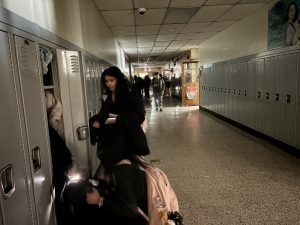
“It was a total shocker; one minute I was enjoying my lunch in a vibrant cafeteria, the next I was in the dark,” said Rohan Nayee ‘28. “Time dragged on, but being surrounded by friends made it better, and we passed the time by playing offline games and chatting.”
Despite the inconvenience, many students found comfort in the shared experience. Without access to Wi-Fi, the newline boards, or the internet, classrooms shifted into slower-paced environments.
“I was in the middle of AP Biology, so we were all surprised when the room suddenly went silent and lost its brightness. I didn’t realize how bad it was until I heard that we were to remain in our current class until the end of the day,” said Furqan Nadeem ‘29. “Fortunately, we were able to wrap up the lesson, and then were able to enjoy ourselves until dismissal time.”
Teachers, too, had to adapt quickly to maintain structure and ensure student safety during the disruption.
“The outage was frustrating, but definitely not impossible,” said Mr. Patrick McCaffery. “My AP Lang students and I made do with what we had. We relied on the offline access of Google Docs for as long as we could, and then concluded the day in the dark.”
For faculty, the situation also required logistical coordination behind the scenes. Ms. Danielle Heath, culinary arts teacher, faced an additional challenge: ensuring food safety and preservation within the building.
“I made arrangements with the culinary teacher at Herbert Hoover Middle School, removed the contents of the EHS refrigerators, and stored everything there,” said Heath. Her decision was driven by food safety guidelines, which dictate that perishables must be kept at 40°F or lower and will only stay safe for four hours during an outage.
The outage also disrupted after-school plans, forcing the cancellation of all extracurricular activities. While many students were disappointed, others appreciated the early notice, since re-entry into the building was prohibited. The notice allowed them to coordinate alternative plans before leaving for the day.
-
During the blackout, students pass the Small Gym as they exit the building. After-school activities and sports were cancelled as a result of the power loss.

-
History teacher Mr. Mike Korneski ’92 walks an almost-empty hallway following student dismissal, as the blackout meant everyone had to leave the building immediately at the end of the day.

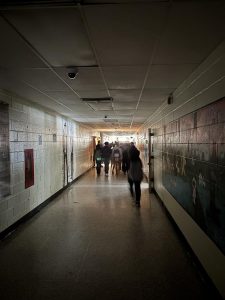
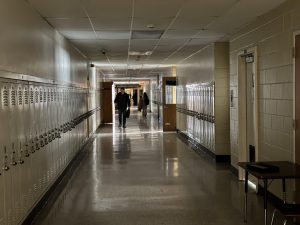
In the midst of uncertainty, many students also relied on their internet-less cellular devices to communicate with family members and stay informed on the situation.
“I felt relatively safe, as I had a cellular device at my disposal, so I could reach out via text if anything were to happen. My worried mother called me as soon as she found out, and I was able to explain the situation, preventing confusion from arising,” said Arni Shashi ‘27.
Shashi’s experience reflected a broader conversation about the role cell phones play in a school setting. While these devices are often viewed as distractions during instructional time, the outage demonstrated their practical value during emergencies. Students were able to rely on cellular data to contact parents, receive updates, and coordinate transportation plans after extracurricular activities were canceled.
In situations where uncertainty can easily lead to concern, immediate access to communication helped prevent misinformation and unnecessary panic.
Principal Mr. Charles Ross also expressed pride in how students and faculty handled the unexpected disruption.
“I was really proud of how everybody acted. All the teachers and students stepped up. We always face challenges, but you have to rise and overcome them,” said Ross.
By the following morning, power was restored, and schedules returned to normal.