
Science is often presented as a collection of discoveries, tied to the names of scientists who have contributed to the advanced technology and extensive knowledge we have of the world today. But many of these breakthroughs are contributions that have gone unrecognized and stories that remain largely untold. Albert Einstein, Isaac Newton, and Charles Darwin are famous names that are easily recognizable, yet only a few people know of Rosalind Franklin, Henrietta Lacks, and Gertrude Elion—the women behind STEM revolutions.
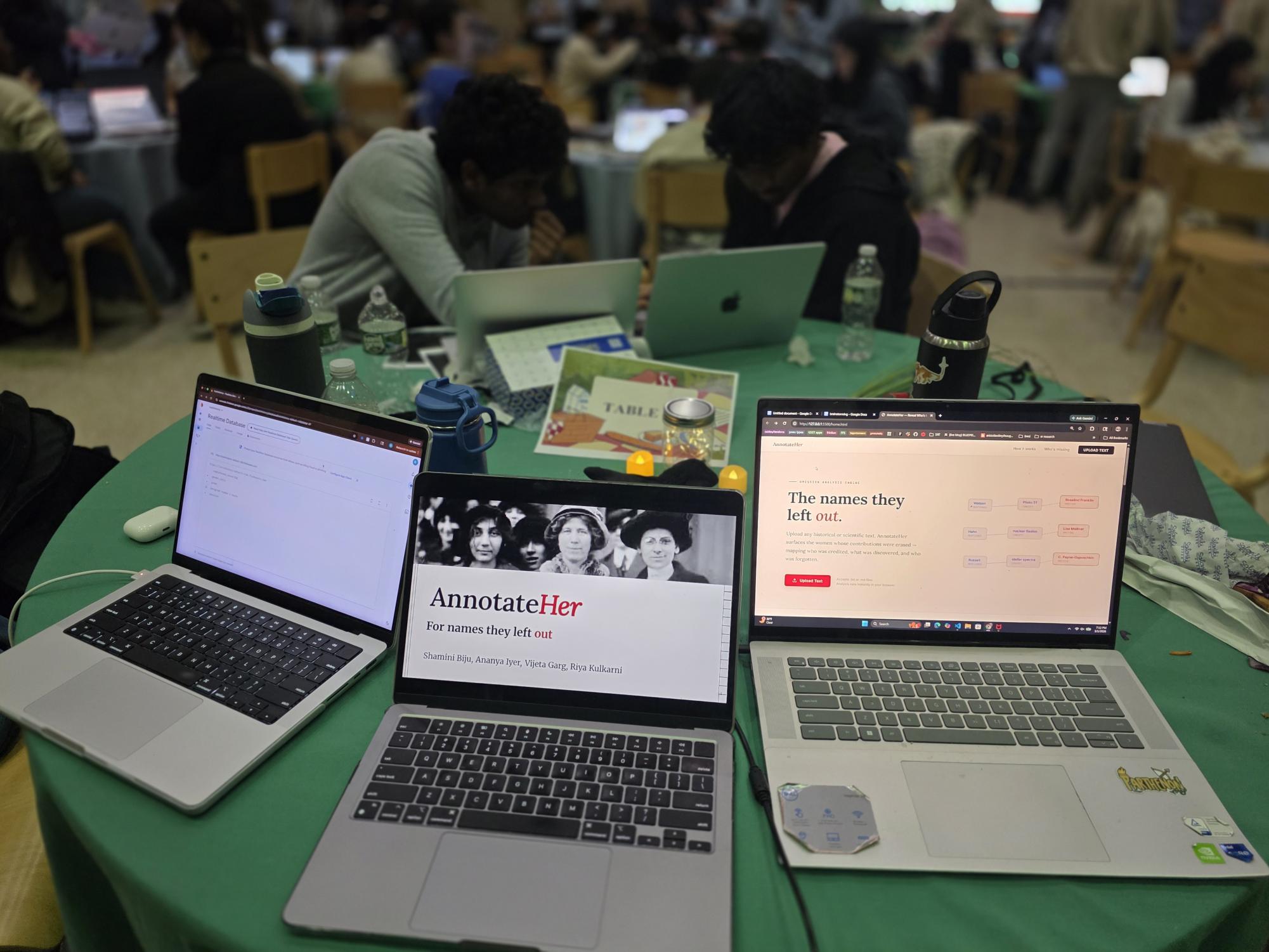
From February 28 to March 1, at HackMIT Blueprint, a global learnathon and hackathon hosted by MIT, one group of high school girls worked to change that narrative. Among them was a fellow Eagle, Vijeta Garg ‘27, whose team built a project that challenged the way scientific history is presented.
“I always noticed in my science and history textbooks that women contributors were barely mentioned,” Garg said. “Sometimes I’d have the opportunity to spotlight a woman in STEM for specific projects, but I always thought they should just be woven into the textbooks we read.”
After researching the issue further, she discovered that this pattern had a name, the “Matilda effect,” and a long history. Motivated by the systematic underrepresentation of women in educational materials, Garg set out to help close that gap.
“I think an underrepresentation of women in such textbooks undermines their achievements,” she said. “Revising history to include such women can motivate women in STEM by helping them see that women did contribute so much to historical advancements, even if mainstream narratives often leave them out.”
During HackMIT, to address this pressing inequality issue, Garg’s group developed AnnotateHer. AnnotateHer actively annotates text with interactive mind maps, visually detailing the connections between women and major scientific discoveries. In doing so, the site offers a more complete and accurate understanding of science.
Working within the constraints of an eight-hour hackathon, Garg and her teammates, Ananya Iyer, Shamini Biju, and Riya Kulkarni, combined technical complexity with a clear sense of purpose. The project required the integration of multiple advanced components, including graph traversal through a curated database of scientists, large language model (LLM) extraction to analyze and interpret text, and dynamic front-end animations to present findings in an accessible way.
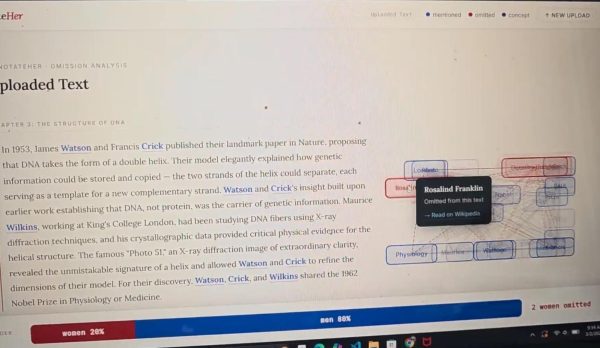
Garg played a key role in retrieving and structuring data and transforming complex datasets into interactive visualizations to clearly display relationships between female scientists and their contributions. This process involved managing large amounts of information efficiently while ensuring that each component of the application functioned seamlessly together under strict time constraints. Through Garg’s work, AnnotateHer was a platform that was both technically sophisticated and impactful.
AnnotateHer ultimately earned third place in the advanced track, but its significance extends far beyond competition results. The project demonstrates how students can use technology not only to build innovative tools, but also to question and improve the systems in our world today.
For Garg, the experience reinforced an important lesson about pursuing ideas with purpose.

“I think if you work on building ideas you think are important, you’ll find that a lot of other people find them important too,” Garg said.
Ultimately, projects like AnnotateHer do more than fill in the gaps of history; they challenge the way knowledge itself is constructed and taught. By bringing visibility to overlooked contributors, Garg and her team are not just rewriting the narrative of science, but reshaping who feels included in it. The names that dominate textbooks may always remain, but initiatives like AnnotateHer ensure they are no longer the only ones remembered. Garg’s effort through this project is the first step for women’s names to be as well-known as their male counterparts for their contributions.