
In the 21st century, Artificial Intelligence (AI) is rapidly transforming industries, careers, and everyday life. Countless educational services have begun to regard AI as both a powerful learning tool and a potential obstacle to personal growth, as it accentuates the learning process but also creates a culture of overreliance on computer assistance.
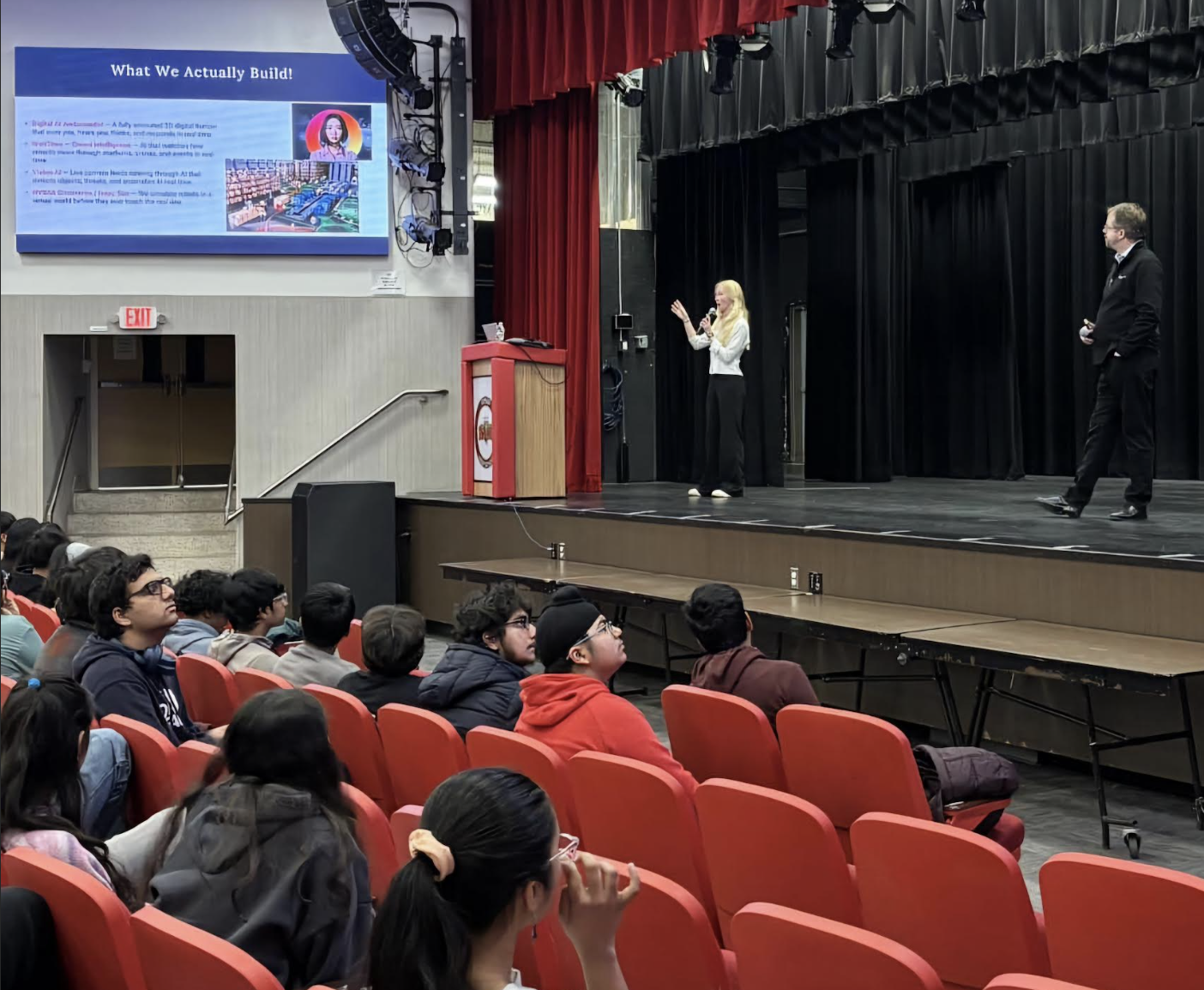
On March 23, Edison High hosted SHI International Corporation’s AI & Cyber Labs for a presentation titled “From Classroom to Career: How AI Powers the World Around You.” Attended by computer science (CS) and STEM Academy students, the event provided direct insight into the effects of AI on careers and industries today.
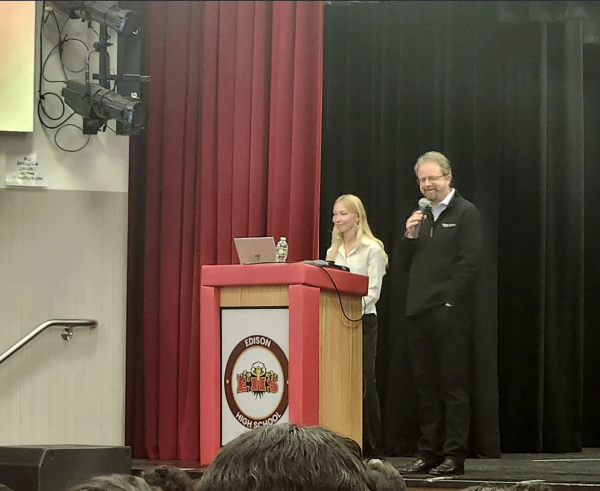
The session was led by Angelina Degay, an associate solutions engineer on SHI’s AI Solutions team, and Henrik Elmgren, an Enterprise Architect specialized in IT solutions. They discussed AI’s evolution from a primarily private tool to a widely accessible resource, specifically since 2022. As a result, new roles have emerged, and expectations across many fields have shifted, automating routine tasks to enable humans to concentrate on higher-value responsibilities.
Within this transformative era, SHI plays a role in developing tailored AI solutions for businesses, fostering authentic integrations. The organization has invented Digital AI Ambassadors, engaging 3D avatars that can respond in real-time to user input. These tools can assist with managing calls, enhancing communication between parties, and even supporting those with social anxiety. SHI has also developed camera-based detection tools, such as VisionAI and WaitTime, that prompt safety and wellness by recognizing potential threats early on.
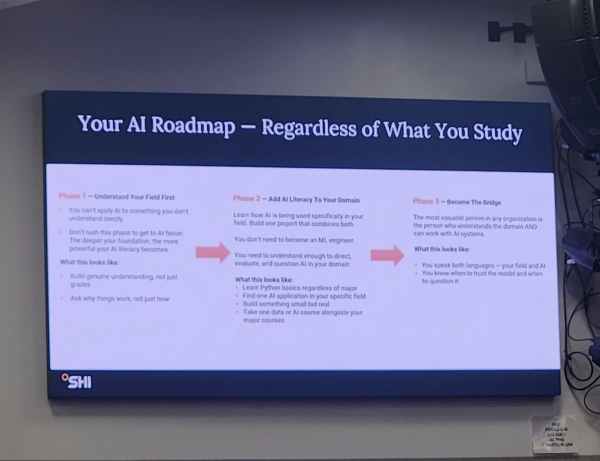
Throughout the presentation, the speakers emphasized a collaborative future, positioning AI as a “partner” that amplifies or corroborates human skills rather than a replacement. They explained that AI is already embedded in everyday systems, from supporting real-time decisions in healthcare to mechanizing minuscule tasks and creating a more personalized user experience.
Degay and Elmgren also discussed platforms and tools that accelerate the growth of AI, particularly those developed by NVIDIA. Omniverse and Isaac Sim are two tools that allow engineers to mimic robots in virtual environments to properly undergo the machine learning process without real-world repercussions. These simulations help developers effectively carry out genuine tests with modern conditions to mimic the settings they will be deployed in.
To understand the technical logic behind these robots, students can utilize Claude, an advanced AI assistant and a family of large language models. Degay explained that this software is free and beneficial for those who would like to gain a deeper understanding of how these virtual parameters translate into real-world robotic code, making complex projects accessible. Students can also create their own projects to provide code for a robot to move.
A key takeaway from the event was the importance of building strong foundational knowledge before relying on AI.
“Learn the profession, use AI to help you, when you feel the response doesn’t make sense, take a step back, fully understand what AI is doing, to see if the generated answer is plausible,” said Elmgren.
This powerful message reinforced the notion that AI should be used thoughtfully, not blindly. An individual should be knowledgeable in their respective fields and use AI as a supplemental tool for assistance when needed, not to take advantage of it.
Additionally, students in attendance found the session both practical and eye-opening.
“I learned that AI is used in many real-life jobs, not just in computer science,” said CS student Yuthiksha Ramalingam ‘26. “It also showed me that what I learn in school, like math and problem solving, is useful for future careers.”
Ramalingam’s experiences highlight that AI is not confined solely to one field, but rather is a tool that connects and enhances nearly every career path that a student may pursue.
“I never realized how much of a difference Prompt Engineering could make; it’s so simple, yet it can completely change the kind of response you’ll get,” said STEM student Vishnu Venkat ‘29.
Venkat’s experience, similar to that of Ramalingam, highlights a fundamental shift in how professionals and students should interact with AI: moving from simple queries to structured inputs that guide the AI towards a specialized response.
With AI rapidly transforming the modern world, educators are focusing on bridging the gap between classroom learning and technical applications.
“The goal was to give students a real-world perspective on how AI is being used across different industries and to help connect what they’re learning in their classes to their future careers,” said Ms. Kristen Tsaoys. “I felt the discussion was incredibly engaging and meaningful, especially in highlighting how crucial it is for students to not only understand AI, but to think critically about its impact and ethical use.”
Tsaoys’ positive experience was in line with that felt by those in attendance. Invaluable information was shared regarding the emergence of AI, benefiting students and educators alike.