









































































Overthinking is like a roller coaster: the cart pushes fast making its way over the hill, then drops, abruptly stopping—just enough to arouse intense sensations. These sensations mirror our thoughts, which surge through the mind just as suddenly, allowing negative emotions to creep in. Eventually, those thoughts fade once we realize we’ve wasted our time and energy on worrying about nothing.
Envision, for example, a student who worries about the possibility of his test score being lower than his classmates’. He begins to undermine his intelligence and assumes the worst. However, he later finds out he is among the top five students in his class to receive the highest score on the test. Suddenly, his misgivings vanish, and relief and calmness abound in his head, vanquishing the negative thoughts that once convinced him he was incompetent and inferior. That is the nature of overthinking: It mentally drains us after painting a false narrative.
Although we dramatize uncertainty, it is important to regulate our thoughts to prevent unnecessary distress.
Negative thinking patterns, including rumination, can interfere with an individual’s self-identity, academic performance and social functioning. While chronic overthinking can trap us mentally, we also have the ability to overcome these disruptive thoughts by practicing mindfulness and redirecting them in more constructive ways.
It is important that we reflect on our thoughts in a healthy way; otherwise, dwelling on negativity can prevent us from moving forward or taking action.
According to freelance Health and Wellness writer Stephanie Anderson Witmer’s “What is Overthinking, and How Do I Stop Overthinking Everything?” rumination involves excessive worry (regretting past actions or persistent indecisiveness) or dwelling on the future or past, which in some cases, can contribute to depression or other mental health conditions over time
We are often consumed by persistent negative thoughts because they demand attention and feel urgent to resolve. While it’s not bad to think analytically, our minds can easily succumb to the trap of over-ruminating.
Sure, reflection can be good as it’s vital to your emotional health, but it becomes unhealthy when that reflection turns into obsessive rumination. Consider an office worker reviewing her work. She rummages through her papers, searching for the “right” version to submit to her boss. After an hour, she finally turns one in. Then to her surprise, her boss is delighted with her project and asks to see more.
Overanalyzing circumstances and decisions can disrupt real life functioning in areas like work, relationships, and education, ultimately impacting mental health.
“The human brain has a powerful way of creating a fake reality,” Ashly Alcequiez Feliz ‘26 states.
Interestingly, perfectionists may be more prone to higher levels of ruminating than the average person due to high standards they set for themselves. However, anyone who constantly overthinks is affected regardless.
Some different types of overthinking, also known as “cognitive distortions” are all-or-nothing, viewing the worst in situations which are relatively similar to catastrophizing, assuming that a minor mistake will lead to total ruin.
Another type is overgeneralizing, to conclude that a single negative event will happen again in the future. Jumping to conclusions is the mind creating a cycle of immediate assumption. Finally, mind reading (the “fortune teller”) is to assume they know what others are thinking about.
Child and adolescent Psychology Resident, Ms. Rachel Suresky, explained that overthinking patterns, particularly catastrophizing, are often associated with underlying levels of insecurity.
“It also might be related to a confidence deficit,” she says. “Perhaps not being confident in a certain area, depending on what the situation is.”
Overall, pouring useless time onto spiraling thoughts impedes you from unwavering focus because the brain is desperately attempting to search for a “good” solution, leaving some individuals stuck in a “fight or flight” mode.
This is due to the brain making an effort to reduce anxiety by testing out possible solutions to a previous or upcoming event which in itself can affect the brain’s neurons.
Glackin provides insight into the chemicals impacting human dopamine levels.
“If we’re causing ourselves stress, then we’re putting into our body hormones like cortisol and adrenaline,” Glackin explains. “Dopamine and serotonin are the two that counteract cortisol and endorphins, but the simple answer to your question is high levels of overthinking or the hormones that come with it, can decrease the dopamine levels in your body.”
Imagine Pac-Man, a lively, yellow, cheerful figure, who consumes dots for a living in order to navigate his way home through a maze while avoiding the four aggressive ghosts who try to trap him. Once those little troublemakers get into contact with Pac-Man, he shrinks. Then dies.
Okay fine, dopamine levels don’t automatically die out after getting combatted by cortisol or endorphin hormones, but they still lose their way home to the brain’s receptor, putting a sorrowful look on the human’s face.
While overthinking impacts everyone, it can especially be harmful to adolescents who experience puberty; teens who may wake up to nasty body odor, undergo sudden growth spurts and deal with awkward voice cracks or skin breakouts, increase their susceptibility to mental health challenges.
An overview done by Teen Mental Health Facts and Statistics shows that 50% of all lifetime mental illnesses begin at the age of 14; in addition, 42% of teens face persistent feelings of sadness or hopelessness.
Realistically, teens become unaware of the importance of recognizing their emotions and behaviors given that their brains are underdeveloped.
But it is not good to normalize the frequency of mental health conditions appearing in them, labeling it as a “regular growing up experience” when it’s revealed to be unproductive, if not unhealthy.
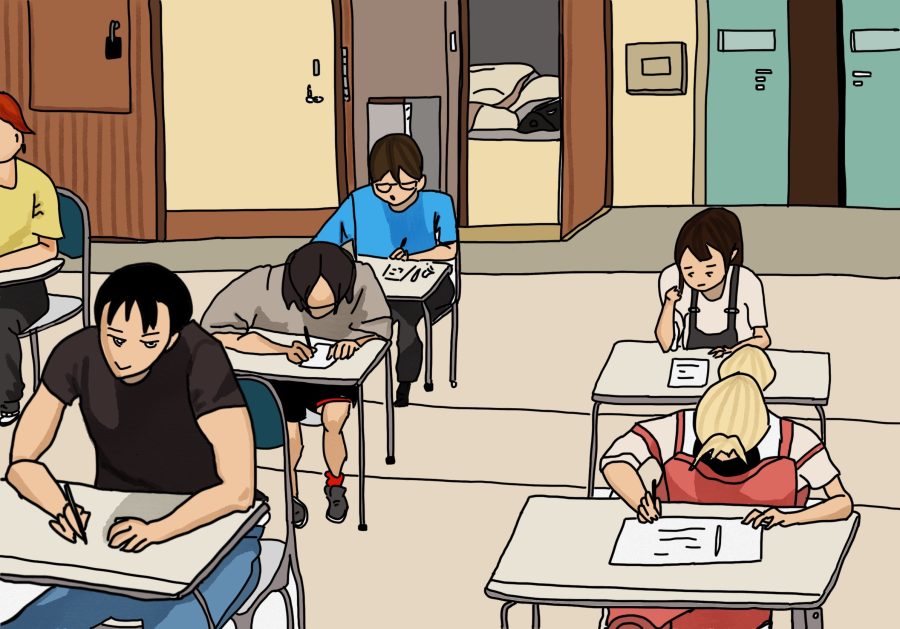
For instance, many students recognize their environment is rigorous in, say, AP and Honors classes, which makes them undermine their skills and intelligence.
Landon Frey ‘27, an AP student at Hunterdon Central Regional High School, states, “You lose your confidence in your responses and your overall cognitive process and your ability to think logically.”
Although speaking up in class or sharing one’s thoughts can feel stressful when surrounded by peers, this is a common experience for many students.
“It makes them question themselves and probably makes them do worse. It hurts their success,” Grant Frey ‘27, another student at Hunterdon Central Regional High School, answers.
This mindset hinders the student from nurturing their progress as they lack the confidence to speak up in class because of pressure piling up on their shoulders. Then suddenly, those thoughts storm in, “students will think I’m dumb” or “I don’t sound sophisticated enough” entertaining the belief that they “don’t belong.”
However, the student overlooks the fact that no matter how big an AP classroom is nor how intimidating his/her classmates may appear, it doesn’t determine the outcome of their performance.
If anything, an AP classroom setting should pour onto the student’s confidence as it fosters their education and will to learn. AP classes should not be a place centered on judgement or competition because students are there to pursue intellectual growth.
Conversely, other kids like to sustain the belief that being themselves is “bad” as they fear to be judged for their authentic persona so they resort to a performative identity.
“They wanna be tough, because they think that vulnerability will make them think that they’re incompetent and weak,” Celina Firuz ‘26 states.
But truly, kids who avoid confronting their emotions or refrain from seeking help fear addressing the underlying problem here.
Landon Frey elaborates as to why that is.
“Because it is hard to handle things alone,” he says, “You don’t have other people to help and give their opinion.”
However, challenging these thoughts alone doesn’t always end up without solutions; in fact, practicing to confront these mental distortions helps to chase them away.
The Overwhelming Mind: How Overthinking Affects Teens and Young Adults recommends adopting mindfulness techniques such as practicing deep breathing in order to interrupt spiraling thoughts.
By doing so, it grounds the person to the present moment, snapping them out of the past or future event.
Other methods include challenging internal thoughts—perhaps converting the negative thought into a healthy question such as asking yourself, “Does it make me feel any better that I think about this on a daily basis?” or “What did I learn from this and how can I take a better approach to the situation moving forward?
Martin gives a healthy alternative.
“Try to not label your thoughts—just be more strategic. Physical activities help with both the mind and body,” she says. “Journal and practice good impactful habits to take action.”
In general, distracting yourself can be an effective way to relieve mental or physical tension as long as it dissociates the person from that hurtful thought.
Firuz adds, “There’s a study that shows that the movement we’re doing right now can relieve stress since it helps to shift our mind focused onto something else.”
Engaging in physical activities such as working out in the fitness center, participating in sports, doing yoga, etc. are all great methods to redirect negative energy and distracting emotion elsewhere.
Or, indulging in hobbies and even other activities like the occasional trip to a fast food place can be productive. Perhaps the occasional trip to Mcdonald’s can shift your focus on the juiciness and tenderness of the burger you’re biting into and away from the distressing thoughts.
Despite the fact that overthinking is associated with a bad reputation, the upsides to them, such as positive overthinking, can be utilized for its good benefits.
One of the properties that positive thinking offers is that you’re able to notice details that others might miss; as meticulousness is useful in problem solving and understanding your surroundings.
Secondly, you’re able to make good decisions when analyzing different possibilities when finding a good solution to a conflict. Over time, you reduce the likelihood of acting off of impulse that one could regret later on.
This enhances your overall critical thinking. Finally, apply positive affirmations into your daily routine as the longer humans adopt this method, the more it boosts their self esteem.
“So I think it’s very much true that the more we can bring ourselves up, the more we’re able to believe these thoughts,” Glackin explains. “The more we chase away all these negative self images, it leads to more positive cognitive function which promotes more positive physiological functions.”
However, positive overthinking skills are not quick to adapt to as they require gradual time to fully develop and internalize.
But can growth arise from converting our negative thoughts into positive ones?
“That’s part of it, I think it definitely does,” said Landon Frey. “But more growth depends on turning it into a habit or practice or action. You can only take a thought so far”
Training our thoughts contains a flexible routine, whether it’s stumbling upon our own thoughts in the shower, or putting any negative thought on “autopilot” mode by listening to music. Overall this requires profound character development and an elevated sense of emotional awareness, but that’s what life is all about for adolescents on the brink of adulthood.
When engaging in these methods, it is also important to recognize that overthinking cannot fully be used as a tool because negative thoughts won’t always be “preventable” or fully eradicated from the mind as humans are going to inevitably encounter them.
“Persistent overthinking, or rumination, is generally considered maladaptive, as it is associated with increased internalizing symptoms such as depression and anxiety,” Suresky stated.
Humans are generally wired to convince themselves more of the bad than the good traits of themselves because they strive for conformity; though this affects daily life activities like gaining proper sleep, social interactions and self esteem.
Suppressing our negative thoughts is never a good alternative either, because the longer we ignore them, the more mentally draining that thought will become, ultimately making us fall into the trap of ruminating.
But the main goal here is to manage our use of overthinking, learn to take control of our mind and don’t allow negative thoughts to emerge to the extent that they limit one’s true potential.
“Humans very rarely will have an all good path or an all bad path; it doesn’t always have just one path. There can be good days or bad days,” said Glackin.
“Ultimately,” he adds, “the goal is to have more positives than negatives.”