






































































Since childhood, we were all raised on the same promise: if you work hard enough and believe in yourself, you can achieve anything. While there is some truth to this statement, there are many who follow this belief but don’t reap the rewards that society promised them. Many people study hard in school, attend college, and secure a job, but struggle to pay for bills and essential goods. Others face racism, gender discrimination, and poverty, further challenging the idea that success is a matter of pulling yourself up from your bootstraps.
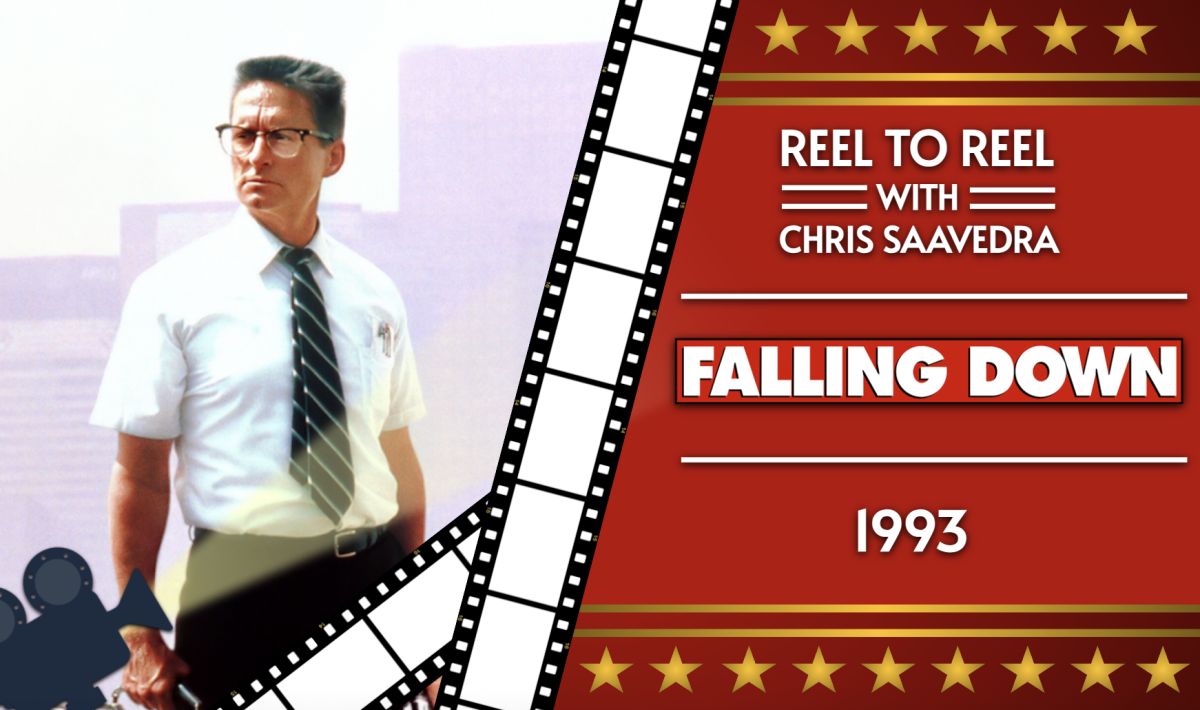
Basically, life simply isn’t fair. This sentiment is seen in the story of Falling Down. Directed by Joel Schumacher, the movie stars Michael Douglas and Robert Duvall. Released in the winter of 1993, the film highlights the hypocrisy of American culture and values, with its message only increasing in relevance as the years have passed. It serves as a case study of the collapse of the traditional American way of life and the dark realities of society.
William Foster is your everyday man who’s down on his luck. His wife has divorced him, and he has lost his job. One day, he’s caught in a traffic jam in the sweltering LA heat. With his air conditioning broken, the heat unforgiving, and the yells of impatient drivers behind him, he finally snaps. Abandoning his car, Foster sets off on foot across the city to his ex-wife’s house to attend his daughter’s birthday party. As time passes, he becomes disillusioned with the world around him, leading him to go on a rampage against a world he sees as corrupt, greedy, and selfish.
Foster embodies the struggles of the common man. His job in the defense sector was his way of serving his country, to “protect Americans from the communists.” He wants to believe there is a still path for him because that’s what he’s been told all his life. He paid his dues and protected his country, so where’s his reward? On his journey, he realizes that his entire worldview was a lie,fed to him by mainstream culture.
When his country needed him, Foster didn’t hesitate. But when he needed his country, he was told to toughen up, get over things, to accept that life wasn’t fair.
At the heart of Foster’s destructive odyssey is a broken man whose entire life was a lie. His anger and confusion about his role in society drove him to insanity. He becomes cynical as he crosses paths with people on the street, wondering how the greedy powers at play amass so much for themselves while so many others live on the streets with inadequate food or shelter.
While his actions are reprehensible and in no way justified, Foster’s reasoning reflects the frustrations of everyday people. Many of us seek to work hard, help others, and try to make it day by day, yet still struggle to find happiness and meaning in a society that wouldn’t care if we dropped dead. We are often rejected and ignored by others when we try to create friendships.
We’ve been doing everything we have been told to do our whole lives. Why does it work for others but not work for me?
The truth is, that’s life. Some things work for some people, and some things don’t. We just have to get back up and keep moving forward. Foster’s story shows what happens when someone lets their pent-up anger, sadness, and confusion consume them and then takes it out on the rest of the world. It’s okay to feel sad, alone, and angry, but it’s also imperative to not let these feelings keep you down.
Falling Down is a fitting name for one man’s descent into madness. It’s a look into the psyche of an individual who’s at their wit’s end and can’t hold back the storm of stress and frustration. It masterfully conveys the struggles of the average person, whose struggles and cries for help are ignored by society, and what can happen if they have nothing left to lose or live for. In that sense, we all have a bit of William Foster within us—we just have to make sure we don’t end up like him.