








































































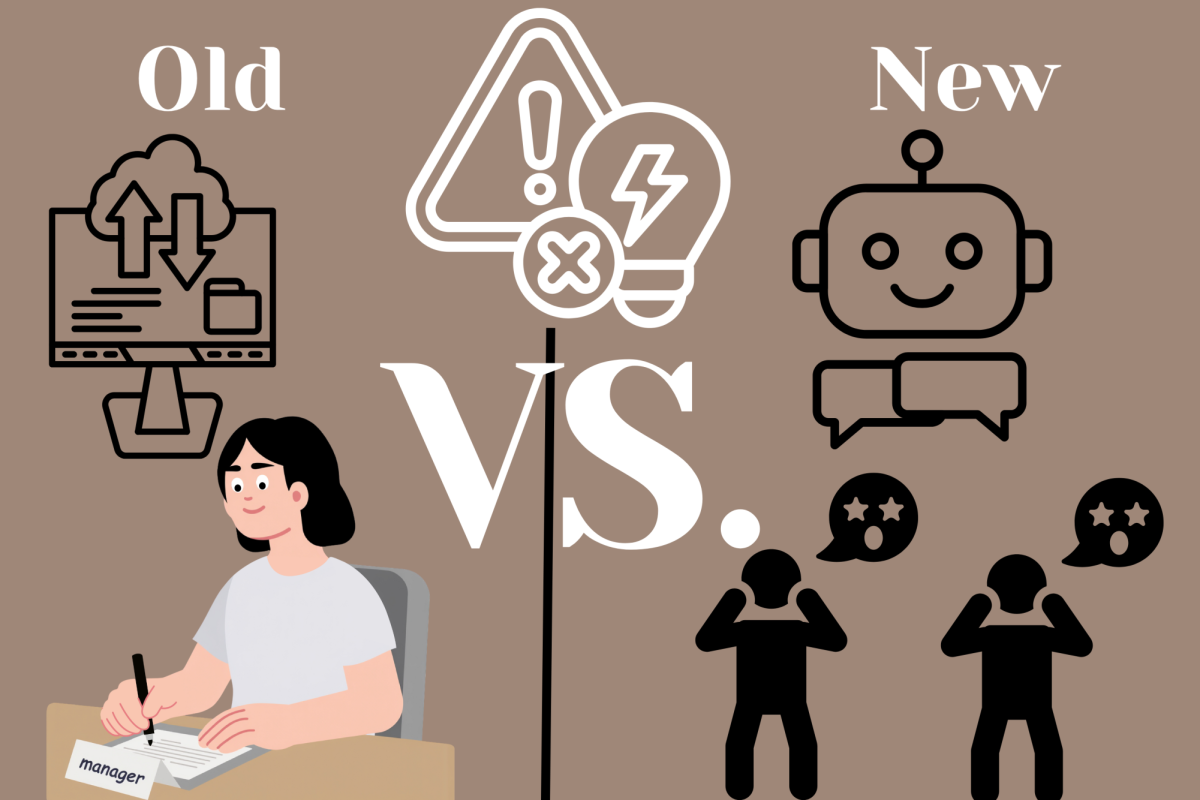
In today’s world, the connectivity our technology permits is remarkable. The ability to call your friend on your MacBook or access immense medical data from all over the world would have been unimaginable decades ago.
American business man, philanthropist and co-founder of Microsoft, Bill Gates expressed in an interview, “It’s easy to look at the machines we have today and say, boy, how did we ever use the machines of four or five years ago? But certainly, four or five years from now, we’ll be seeing the same thing.”
However, while some are hopeful about the future of better device and system integration, others are wary, specifically due to recent infrastructure failures that impeded internet service worldwide. Ultimately, it all leads us to the same question: Is the digital connectivity we have today actually worth the productivity it brings, or is it time to return to the individual databases and discontinuity of the 2000s for their safety nets?
Back then, in the late 1990s and early 2000s, the most important data was backed up and stored in multiple places, both digitally on databases and physically on paper. In addition, when data was stored digitally, separate systems were used to store copies of that data; these systems were rarely interconnected and often depended on one another. If you needed to find your SAT or AP scores, for instance, while it would take a couple of months to process and receive your scores, there tended to be fewer discrepancies with switched scores and incorrect general information, such as housing information. Even when these mistakes occurred, there was less confusion regarding the procedure to correct them.
While time was the primary negative consequence of these systems, they were built on redundancy. Important data was stored digitally and physically, and failures in one system rarely impacted the rest.
However, what about the situation today? Well, technology continues to improve every day. For instance, a year ago, AI was wildly inaccurate. And two years ago, the concept of AI use in most public settings didn’t even exist. In addition, you can edit videos, photographs, call and text others, watch social media, play games, view webpages, and so much more just on your phone today. All of this power, quite literally at one’s fingertips, stems from the modern digital connectivity mainly enabled by Amazon Web Services. According to Statista, AWS controls approximately 31% of the global cloud infrastructure market. When users stream a show on Netflix or even open a web page, they are relying on AWS servers. This mass use of AWS has led to efficiency and global connectivity, but also created a vulnerability. When AWS experiences a server outage, it is not just one company’s server that goes down, but rather its thousands of services.
The extent of this vulnerability became clear two months ago. As reported by CNN, the outage of October 2025 affected users on Snapchat and Fortnite, and even caused businesses to not be able to process payments. But beyond the inconvenience to users, according to estimates, companies can lose anywhere around 75 million per hour during AWS disruptions.
The October outage lasted over 12 hours and was caused by a DNS resolution failure, which prevented machines in AWS’s US East region from recognizing and utilizing web domains, resulting in devices being unable to locate and access webpages. Moreover, according to NBC, AWS’s own support ticketing system crashed, meaning companies couldn’t report problems. Financial services such as Robinhood and Coinbase were unable to access their funds. Sites such as the McDonald’s app and gaming platforms such as Fortnite were affected. When one company fails and numerous services crash, that’s not the essence of connectivity but rather a vulnerability in today’s world.
Yet the problems are beyond AWS. Another major disruption in early December revealed another concern about digital infrastructure. However, this time the cause was Cloudflare, a company handling DNS and security for numerous websites. AI platforms, gaming platforms, and so many more all failed, and the internet, filled with doubt, placed the blame on AWS.
This confusion exposes the problem itself: Our internet requires infrastructure dependent on one another. When AWS is working, a Cloudflare failure, which provides security for those web pages, can make those services unavailable to users.
Furthermore, these services that nearly everything else is dependent on are also dependent on each other. For example, AWS depends on Cloudflare for some services as well, so as you can imagine, when Cloudflare shut down, so did parts of AWS. This interconnectivity essentially acts as a bulletproof vest: It works perfectly, but once you hit the weak spot, the whole system comes apart.
Both the 2000s and 2020s have had their strengths and weaknesses when it comes to technology. What the 2000s lacked in smoothness and connectivity, they made up for in resilience. Systems were less interdependent, failures typically impacted one system, and technology functioned as a tool rather than a necessity in our everyday lives. After all, everyone in history has looked to the past nostalgically for a escape. It’s time for the 2020s to look back on the past as well.