



























































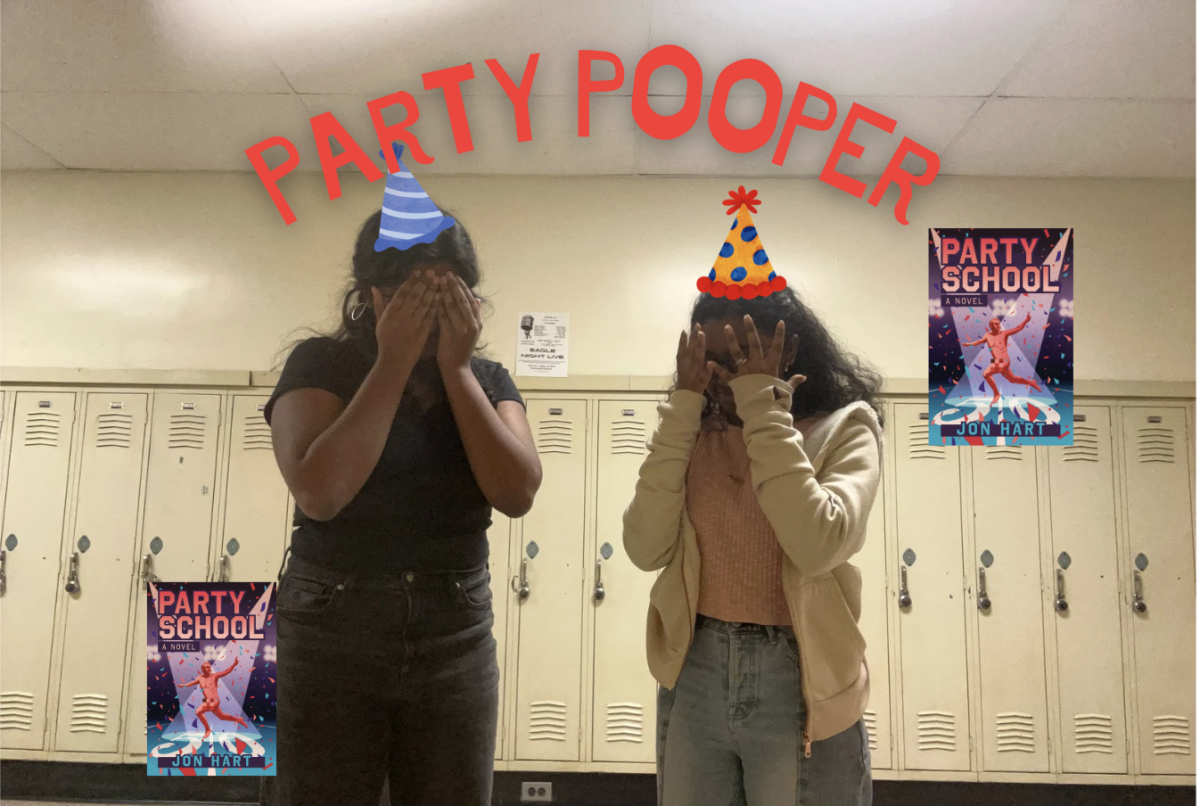
Ever heard of those crazy college stories with passionate football games and even more passionate alcohol consumption? Party School, by Jon Hart, might be where those rumors started (don’t check the date!). A moving story following Dylan Mills, Party School is the story of a seemingly normal high school senior entering his freshman year of college. Filled with fear, hesitation, confusion, and eventually clarity, Hart’s story might be the lighthearted read we need for this college decision season.
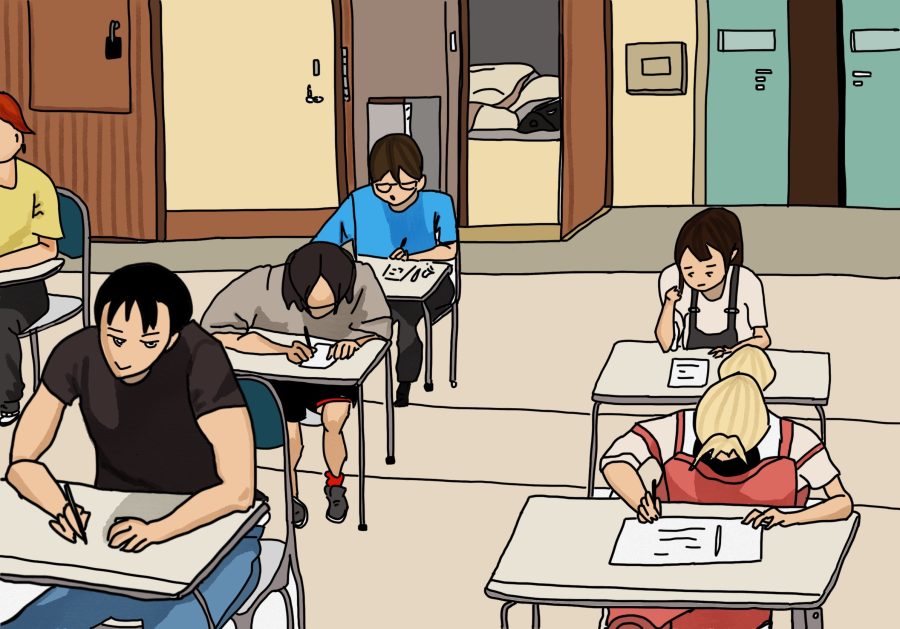
By mentioning topics like the “extracurriculars race” and “SAT scores,” Hart proves that he understands the typical high-schooler. Caught between high-achieving peers and demanding parents, both Dylan Mills and EHS students live stressful lives, filled with unexpected twists and turns. Especially with college decisions, this book is timely in that readers may understand Dylan’s struggle to fit in with his school, validating many real-world emotions.
However, at the same time, the language used in the book leans heavily toward childish. Despite being aimed at an older age group, the words and phrasing are better suited for middle school. The included humor is, frankly, not funny. Instead, the jokes come off as cringy and even inappropriate. Ultimately, Hart’s novel did not have the fluency or the appropriate match of words to meaning necessary for a good read.
In addition, the story’s plot itself was flawed. Littered with plot holes, we were left confused amid the chaos. The college students in the book, including Dylan, are excessive alcohol drinkers, among other substances, a topic which the plot revolves around. Certain character changes and plot events are out-of-the-blue and unexplained, adding to the confusion. Even if the plot was supposed to reflect the chaotic nature of college, balance is crucial, a quality Hart fails to achieve .
Dylan’s moment of redemption also seems rushed and immature. While it is understandable that Hart attempted to create a lasting impact, the way he writes the climax has readers questioning whether the novel encourages Dylan and his friends’ questionable actions. Additionally, Hart’s attempt at a conclusion disappoints readers with its lack of depth and meaning. Despite spending over two-thirds of the book building up to the so-called resolution, it seems as though he drove himself into a corner, tying up the loose ends in a shallow manner.
Party School had the potential to create a meaningful resolution, but Hart did not deliver. Although the concept of the stress and issues surrounding the transition from high school into college was an interesting idea, Hart ended up turning the plot into a rant, even using other “prestigious” colleges as a target. He had the opportunity to use the novel as a way to encourage and reassure students about their college decisions and instead made it seem like certain colleges were better than others.
So, take our advice: Party School is an invitation that you’ll want to decline.